
What is Photogrammetry
Photogrammetry vs 3D scanning is one of the most common comparisons in modern 3D printing workflows, especially for industrial and mechanical parts.

Photogrammetry is a technique that creates 3D models by analyzing multiple photographs taken from different angles. Specialized software detects common points between images and reconstructs the object’s geometry in 3D space.
This method relies heavily on good lighting, high-quality photos, and surface texture. Objects with rich visual detail produce better results, while reflective or smooth surfaces often require surface preparation.
Photogrammetry is widely used in product visualization, cultural heritage preservation, and hobbyist 3D printing workflows where ultra-high precision is not mandatory.
What is 3D Scanning

3D scanning uses dedicated hardware to capture the exact geometry of a physical object. Instead of photos, scanners project structured light or lasers and measure surface deformation to build an accurate 3D mesh.
This method excels in precision and repeatability. Industrial 3D scanners can capture fine tolerances, internal edges, and complex mechanical details that photogrammetry often misses.
3D scanning is commonly used in reverse engineering, quality control, and professional manufacturing workflows.
Accuracy and Precision Photogrammetry vs 3D Scanning Comparison
Accuracy is the biggest difference between photogrammetry and 3D scanning.
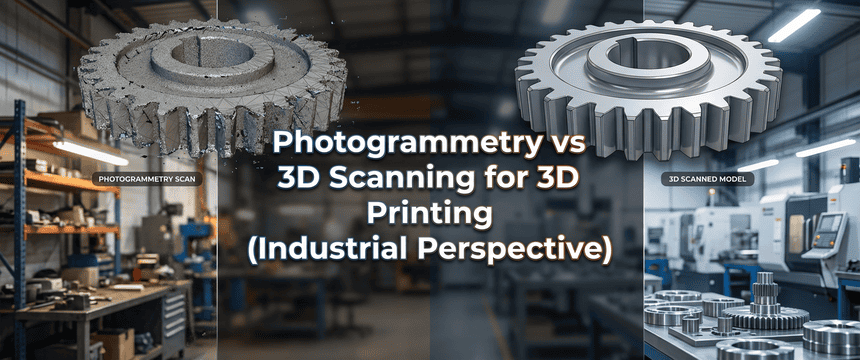
Photogrammetry produces visually accurate models but often lacks dimensional precision. Small holes, sharp edges, and exact tolerances may be distorted or lost during reconstruction.
3D scanning, on the other hand, is designed for dimensional accuracy. The resulting models are suitable for mechanical fitting, tolerance-critical parts, and engineering applications.
Post-Processing Workflow
Both methods require post-processing, but the workload differs significantly.
Photogrammetry models usually need heavy cleanup: hole filling, mesh smoothing, remeshing, and sometimes manual reconstruction of missing geometry.
3D scanned models often require lighter processing, mainly alignment, noise reduction, and minor surface cleanup before being ready for CAD or 3D printing.

Industrial Use Cases
In industrial environments, the choice depends on the application.
Photogrammetry is useful for:
- Large objects
- Visual references
- Non-critical decorative or conceptual models
3D scanning is preferred for:
- Reverse engineering
- Mechanical components
- Replacement parts
- Quality inspection and tolerance verification

Which Method Is Better for 3D Printing?
For decorative, organic, or artistic prints, photogrammetry can be sufficient and cost-effective.
For functional parts, mechanical assemblies, and precision prints, 3D scanning is the superior choice. It reduces trial-and-error, improves fit, and saves time during production.
The best workflow in many professional settings combines both methods depending on project requirements.

FAQ
Is photogrammetry accurate enough for 3D printing?
Photogrammetry works well for visual and decorative prints but often lacks the dimensional accuracy required for mechanical parts.
Can photogrammetry replace 3D scanning?
No. Photogrammetry focuses on visual reconstruction, while 3D scanning is designed for precision and engineering accuracy.
Which is better for resin 3D printing?
Photogrammetry can work for organic shapes, but 3D scanning provides better results for detailed and dimension-critical resin prints.